linterry's blogger
水曜日, 8月 31, 2005
Chmmr
Inside the taxi I sat directly next to my girlfriend’s sister Yuri, and I distinctly remember the skin contact between my arm and hers. On a Social Ego projection level I am obliged to dismiss this as a completely irrelevant and unimportant event, yet memory is very selective and the fact that I can still remember that moment with strong clarity suggests that my subconscious id begs to differ. I cannot, for instance, remember any of the dialogue that went inside that taxi. All I can remember now is that moment of skin contact.
We then arrived at Yuri’s friend’s house, at which point we had to move all their bags to the nearest bus stop. Once again I pro-actively volunteered to carry the heaviest bag - oh how it felt so wonderful to be seen carrying the heaviest bag. Of course, this was only possible because I was the only male in the group. If there was another male I doubt I could compete for the rights for the heaviest bag. In that situation I would have felt extremely useless and this whole positive experience would have flipped around into a negative one. But luckily for me, it was just four females and I had such the honor of carrying the heaviest bag. Every time Yuri tried to lift the bag and couldn’t, I had this irresistible compulsion to barge in and carry it for her. It made me feel so proud.
Incredibly, after the whole group left for the airport, I found myself behaving in front of Shinobu for the next hour. It was as if I could not stop projecting my Social Ego afterwards, however the lack of an appropriate target for my projection somewhat disturbed me. My girlfriend was also in a state of restlessness. The following incident was extremely interesting: We had already boarded the Xindian MRT at Taipei Main Station, but immediately after boarding I faintly suggested that we get off and take the bus to CKS Airport to see Yuri and company one last time. My girlfriend, who was already in a mentally disjointed state, immediately got off. I was surprised at her immediate reaction and asked out “wait, are we really going to the airport?” After that she got extremely irritated because I was only amplifying the internal indecisiveness within her: she wanted to go to the airport, but on a rational level it seemed almost pointless for her to go. Indeed, I felt that both of us were feeling the same thing: it’s just us again, and that really sucked, because projecting Social Ego’s felt so darn good. We were hooked, and all of a sudden we could not taste the pleasure anymore. However, the fact that we might be seen as people with too much free time was enough discouragement for us to just wait for the next Xindian MRT. It seems that although our minds seek to project our Social Ego’s, there is also an unwritten rule that says “Don’t force the situations outside social customs otherwise you will be seen as lonely and without value.” This only reminds me of that statement made by Satan in The Devil’s Advocated: God gives us instinct, only to set the rules in opposition.
Particularly, I still remember last night how I was showing Yuri the Google Earth software, and feeling so satisfied how I managed to retain her attention for a full hour. I slept so well last night, going to bed with such a happy glow that it almost irritated my girlfriend. “Demonstrating Google Earth” now has a batting average of 2/2, I also used it with Shinobu’s other friend Yohko and it bought me about an hour of ice-breaking which in the end, turned out to be invaluable. It’s strange that Google Earth has more practical value to me as a ice-breaking tool with females than it does for say… actually satiating any personal interest in the world around me. At the beginning, yes, I was genuinely interested in the software, but since the pleasure was solely linked to forming fresh neuronal connections, the “addiction” only lasted a week at most. However, if Google Earth had some kind of EMR activity built-in, for instance, if it had these empty slots for pictures that were just begging to be filled in, then I would be double-clicking on that icon every day. While it does have image overlays, it always ends up feeling like a hack that doesn’t belong. I guess what I mean is, if Google Earth shared some of the leveling up properties of Diablo, it could turn into one mean addictive son of a bitch. Instead we can only get the level up jollies from upgrading the software itself, and that is entirely under Google’s control.

Pkunk
Of course, there’s always a catch. Man was not meant to live in paradise forever. I had to learn this the hard way. No matter how good life gets, no matter how great a place you might be, no matter how many things you might own, it is only a matter of time before they all become meaningless. It’s fucking homeostasis. It’s our ability to adapt to any given circumstance and render its perception into nothing but common normality. We are doomed to perpetually run on a hedonic treadmill, always wanting more, always wanting something new. Look at how fast we buy and throw away cell phones, clothing, computer parts, IKEA furniture, video games, it’s just insane. Consumption rates for all kinds of commonly desired commodities increase every year just to keep us feeling okay. There was a time when humans could be satisfied with a little house on the prairie with a family, bread and water. But now we need a car, a computer, the Internet, parties, new shoes every month, a chemical armada of cosmetics, all kinds of chemical food enhancers - even after we have all this, still we just feel… okay. So the rates increase. More computers, faster internet, wilder parties, even more shoes; the treadmill never stops. There is so much collective desire in the world it almost boggles the mind how much total effort is rendered into keeping the desire in check. It’s like a black hole. It just never stops sucking shit in.
If only there were a way to circumvent homeostasis; a way to undo the adaptive process and to restore attention spans and pleasure sensitivity. Wouldn’t this be wonderful? Instead of wanting more and more and more, mankind as a whole could gradually be satiated with less and less and less! What a concept. The problem is, it just doesn’t seem possible. It’s against the rules of biology and the way we were built. We were built to want more and more, not less and less. The only possible hope is if somebody develops a miracle drug the hijacks the most primitive areas of our brain. Only then can we undo the relentless expansion of our desires into pathological levels. However, given our current state, what pharmaceutical company would want to develop such a drug? It would be the end of capitalism as we know it.
火曜日, 8月 30, 2005
123
Blogging for Microsoft Word may seem like a totally insignificant trinket, but in terms of the mind->web transition process where the motivation to express can be lost within seconds, it’s quite the godsend. Even though there is a “Preview Post” button in the Blogger.com web editor, I never use it. Mysteriously I am a slave to this process:
- Publish As-Is
- Read my own post on the Live Web
- Find a mistake or something I would like to change
- Re-edit on the web
- Repeat until the effort of re-editing outweighs available motivation
The effort cost is really the 10 seconds or so before wanting to edit a post and bringing it up on the web. However, if I edit through Microsoft Word, re-editing can occur as quick as my mind desires through a simple Alt-Tab, as the Microsoft Word session is left open even after the Publish command is issued. I suppose one could say that blogging through Microsoft Word itself intrinsically encourages re-editing.
The other strange phenomenon is that since the blogger.com edit window size is fixed at about 10 lines or so, it becomes difficult to edit the document as a whole. However, a Microsoft Word window is much larger, thus it seems to encourage multi-paragraph posts because there is some kind of instinct to “fill the window up”. Whether this is a good or bad thing for the typical attention-deficit reader is probably another issue, but it’s just interesting how small changes into the process can trigger extreme variations in behavior.
And finally, the better spelling. Despite the fact that blogger.com has a spell checker built in, the problem is that clicking on that button triggers some HTTP request which will inevitably result in delays in the hundred millisecond range. End result: I never push it. I absolutely hate pushing a button that requires me to wait more than 50ms (just think of multiplayer Quake). However, Microsoft Word encourages good spelling by automatically highlighting the wrong words as you go, and those ugly red underlines just triggers some kind of instinct to eliminate them - thus without expending any more conscious effort on my part, I can get better spelling overall.
Canon IXY Digital 600 (IXUS 700)
The other negative of this camera was its rather tiny and flimsy mode-select knob. It felt difficult to turn the knob instinctively and constantly required re-adjustments of the motor areas of the brain.
The positives of the camera was that it was very responsive in many key areas. The startup time was incredibly fast as the camera lens extends to full length almost twice as fast as previous Canon models. The AiAF (Autofocus) was also sped up greatly, as the camera located the subject in less than 300msec (older models sometimes needed more than a full second). And of course, the 60fps recording mode works as advertised. It is almost eerie watching the world captured at 60fps through a CCD, it feels like motion is “SuperSmooth”, that is, it’s smoother than real life. This kind of visual phenomenon is quite mysterious and probably has a biological relation to how the eye translates visual data to our brain.
Really, if only the LCD screen was as good as the Powershot A95’s, I would have been craving for this camera. If there was a single notebook out there which had an authentic 6500K display, I would be craving for that too.
These past few days...
The other necessary requirement is the presence of EMR-related activities. Whether it’s a go-happy traveler wanting to check off a list of “Places to See”, or go-happy shoppers on a perpetual quest to expand their clothing possessions, there has to be some kind of activity that drives the expectation-motivational centres of the brain. Otherwise, it will all seem kind of pointless - comforting perhaps, but without the pleasure spike of having some kind of goal. This can sometimes be intertwined with Company, if a girl I’ve been lusting over is coming on the trip, then it really doesn’t matter where we go, it will be a pretty fucking kick ass trip, unless she ends up totally ignoring me or hooking up with another guy, which will result in the opposite opinion (a lame-ass trip). It would seem that dopamergenic EMR-related activities, if present, tend to take precedence over everything else, simply because they offer more sheer pleasure than say forming fresh neuronal connections, which is something more mild.
If you mix New Environment (fresh neuronal connections), Company (pleasure of Social Ego projections), and EMR-related activities (stimulation of the meso-limbic system of the brain), then this cocktail is sure to drive the mental state into some sort of mild, temporary euphoria. Unfortunately, thanks to homeostasis, when you come back home, it all comes crashing down again, and there is likely a brief period of post-vacation depression as the mind is forced to re-adapt to a lower level of mental stimulation.
978-KILL
Lunches are the worst. For some mysterious, cosmically unexplainable reason, during lunch I feel like my mind is blasting off in a hundred different directions simultaneously and I tend to press hard on my temples in an attempt to “keep myself together”. I ramble on about the same shit over and over, mostly about homeostasis (so fucking tragic) and the hedonic treadmill (normalization). My girlfriend is totally disinterested, after all she’s heard it a hundred times, and with some effort and more temple pressing I can somewhat empathize. But the underlying intrinsic force that instances itself over and over is the same: the mind blasting off in a hundred different directions simultaneously. I cannot stop it. I can only mitigate its effects.
I also tend to misbehave before and after lunch, cussing and swearing at nothing in particular, yelling meaningless profanities like “Fuck you bitch, I’m going to fucking kill you, bitch, Yeah? You think you’re tough Bitch? I’m going to fucking kill you, bitch.” Strange isn’t it? I honestly feel like a psychopath when this happens, and that’s the strangest feeling in the world. It’s like my mouth is moving involuntarily while another person inside me is telling myself “fuck, I’m crazy” - but unfortunately that’s largely in the background.
The miracle “cure” for all of this is to stand within distance of people who automatically engage my innate Social PR program. These are usually friends and non-immediate family ? basically anybody but my girlfriend, parents, and total strangers. In Japanese we usually call these group of people tanin(他人), literally other people. In the presence of a tanin, I magically find all the required motivation to straighten myself out. I stop putting my hands in my pants, I carefully monitor what I say, I stop rambling incessantly. It’s almost like there’s a magical internal switch labeled Behave and Advertise Yourself that’s tucked away in my brain somewhere, but I don’t control the switch. It turns on when there is at least one tanin within the sphere of attention, and it turns off when there are no tanin in the sphere of attention. It’s as simple as that, really.
This effect, or what I also refer to as a “Projection of the Social Ego” is something I have found to be universal across human beings worldwide. We seem to develop, at some time during puberty, an instinct that tries to promote ourselves to the world around us. The only difference is the method. Some people prefer the direct method, others go for subtlety.
土曜日, 8月 27, 2005
Devil's Advocate
God is a prankster. What does he do? He gives us instinct, and then sets the rules in opposition for his own personal amusement. He’s a fucking sadist!
That’s the story of my fucking life.
木曜日, 8月 25, 2005
OMFG
Scroll down to the first picture
How the FUCK did I end up there!!
水曜日, 8月 24, 2005
the state of the mind
It disturbs me to realize that opinions are so fleeting and are so contextual with regards to the mental circumstances in which they are made. It’s a mysterious pattern that can really only be explained satisfactorily by neuroscience. Nowadays I am hyper-sensitive to my own emotions, and I am fairly certain that within the context of “Eating Foods in a Foreign Place”, the mind is flooded with positive brain chemicals, thus satiating it for the short-term and freeing it temporarily from its unrelenting thirst for positive stimulation. In this state of mind it’s just that much easier to talk and smile; conversation becomes free flowing and the mind is further flooded with even more positive chemicals that make the whole experience an extremely positive one (thus eating out with friends becomes a habitual pleasurable experience).
On the flip side, have you ever noticed how when people just meet up, let’s say somewhere near a restaurant, and there’s like a 10 minute walk, the conversation, if any, is extremely lousy? You’d think that conversation is just conversation; whether it’s at the dinner table or while walking after the initial meeting, it makes little difference. But in fact it’s a world of a difference. Without the flood of positive brain chemicals there seems to be an intrinsic difficulty in talking freely. This may also be associated to our pressing desire for approval - the mind is subconsciously trying to figure out what sentence will earn us the most respect from the group immediately surrounding us, but within the dynamics of group walking it becomes a huge problem as nobody naturally has anybody’s attention - it has to be unpleasantly forced. Furthermore, during group walking inevitable distractions also cut attentions unpleasantly thus de-motivating us from naturally speaking out during group walking. The only motivation I can find for forcibly speaking out is so I'm not the only one left with nobody to talk to.
I also find it strange that when a semi-unfamiliar guest comes over to our house it is far more difficult to engage in natural conversation than if we were located in a neutral space like a coffee shop (which is probably one of the best locations for conversation-inducement). There is a certain degree of discomfort with a quasi-stranger invading my territorial space, so conversation becomes more difficult as the brain is flooded by negative feelings. It does feel as if sometimes, all I need to do to become a good person is to find ways to flood my brain with positive feelings. Then becoming a good person is effortless. When the brain is flooded with negative feelings, becoming a good person is realistically impossible.
I stand firmly by this belief: in order to satiate a mind, you can either spend 1,000,000 units of effort to change the world according to his desires, or you can spend 1 unit of effort to inject crack cocaine into his system. Either way the net effect is the same. It’s “common knowledge” that the state of the mind depends on exterior circumstances but this is only a half-truth. The perception of exterior circumstances is also heavily influenced by the state of mind. In other words, when we are feeling good, the whole world is filled with philosophical beauty and we can rationalize to our heart’s content on why it is that way. When we are feeling lousy, the whole world seems to transform into some kind of personal hell and we can also rationalize to our heart’s content on why it is that way. This kind of two-way feedback system makes it nigh impossible for a human to remain “objective” about anything.
However through our favorite tool: rationalization, we can at least give a semblance of being objective. Rationality is like a chameleon: it bends and twists to serve our true objectives which are known only to our subconscious. Instead of revealing the truth, rationality only clouds it further. An example: “Why should you waste so much effort on him if he doesn’t respect you?” A statement like this sounds pretty and logical, yet in context of raw instrumentality it is utterly useless. It does not address the underlying motivational drive for restoring lost approval and regaining a viable sex partner. Instead it pits the listener’s own subconscious against their conscious, thus leading to feelings of indecisiveness and helplessness. I feel in general, if we are unable to empathize with the subconscious motivational drives of the limbic system, we should refrain as much as possible from spouting useless rationality in order to solve other people’s problems, because usually they just make things worse.
After all, if rationality were the core driving force behind the human species, then social problems such as starvation, racism, crime would immediately cease to exist as they serve no rational purpose. Yet the uncanny persistence of these problems only show us one thing: the true driving force behind the human species, the one that will never be conquered despite all the efforts put into education and sagely advice, are the subconscious motivations of the limbic system. The selfish desires to improve, level up, gain approval, and such are the ones that dominate all other competing forces because of their intrinsic power to give us blissful pleasure. From a rationality perspective it does seem odd that women in first-world countries feel compelled to buy five new shoes every year and change their hairstyles every two months. It would be far more rational to donate the four extra shoes to people who don’t even have shoes to wear. But from a subconscious limbic-system motivational perspective, these kinds of behaviors only make perfect sense. The fact that we can produce enough food to feed the world and yet millions are still starving just show one thing: subconscious limbic-system motivations are far more powerful than our piddly ability to rationalize.
月曜日, 8月 22, 2005
The answer to this phenomenon seems to lie deep within motivational psychology, or at I believe it does. Computers and TV's with remote controls share a key property: quick gratification for microscopic effort. It does some good to measure the speed at which computers and TV's repsond to our will...and usually it can be measured in seconds if not milliseconds. With a simple muscle gesture, pages of information are recalled according to our will. With another simple muscle gesture, we can bathe in the soothing company of our peers. The amount of physical effort required to produce our desired results on a computer or TV is practically non-existant. This is no accident: it seems to be a universal goal of modern society to reduce the time between impulse and results. This feeds the natural human aversion to exterting effort.
Compare the effort to result ratio to a "traditional" activty such as, say, going for a walk. Going for a walk can feel very good, sometimes even better than another useless net-surfing session, but in the scope of today's modern gratifiying devices, it just requires too much effort. How much effort? Well, you have to get dressed and walk out the door. Doesn't seem like that much of a deal on paper, does it? But when going up against computers/TV, that's enough to make it a loser in terms of competing for our motivational attention. For traditional old-fashioned activties, the time between impulse and results is measured in minutes, whereas computers and TV are measured in seconds or milliseconds. It just can't compete. It's like a small retailer going against Wal-Mart. It just can't compete.
Mindless web-surfing and channel surfing have thus developed into autonomous behaviors - people will endlessly repeat these activities whether you want them or not. Even when armed with the knowledge that such activities have little or no instrumental value, people still cannot stop. I suppose you could use the word addicted. Why don't people get addicted to taking walks? Well, I suppose if the reward-delay of taking a walk were minimized to seconds, it would be more popular. It could become an autonomous behavior. Nowadays, for a minute of effort, you'd better reward the average human with a big fucking blast of dopamine, otherwise nobody will bother.
The other phenomenon I am puzzled by is the "study at fast food restaurants" phenomenon. Today at MOS Burger I was intrigued by the fact that 80% of the customers came alone and that practically 100% of this 80% brought pens, papers and books. It seems people don't really come to MOS for the food per se, but as a "concentration-inducer". I empathize becuase I do the same thing. When I'm in a neutral space like MOS my mind is freed from the unrelenting desire for quasi-instant-gratifying activites, becuase there are none! The nearest usable computer or TV is a bicycle ride away, thus eliminating it's quasi-instant-graitfication advantage. Then, I am able to produce the motivation to actually get stuff out of my bag and write, think, whatever.
You ever know poeple who purposely delete a game from their HD because they need to concentrate on something... like say studying? And then you wonder "what's the point, you could just re-install it?" Becuase by deleting it, it increases the delay between impulse and gratification from a mere three seconds to three minutes. Thus, it significantly decreases the appeal of this activity at any given moment. Believe it or not, this kind of subvertive, indirect form self-control actually works! After deleting a game, I often find myself saying, "Ok, fuck this, let's play some WoW" but when I find that the icon is missing from my desktop, I end up not even bothering.
It would thus seem that:
Motivational Drive = Expected Reward / (Delay x Effort)
I am now somewhat afraid of the computer. The modern form does not give particularly good rewards, but the delay and effort is so minimal that the net motivational drive skyrockets - thus giving it it's addictive potential.
Arsenal
New feature: Blogging direct from Microsoft Word. You know what effect this will have on blogging worldwide? Better spelling.
金曜日, 8月 19, 2005
- Naruto: Uzumaki Shinobiden
- Ape Escape 3
- Winning eleven 9
Naruto: Uzumaki Shinobiden: 5/10
Completely thoughtless. Playing this game conjures up images of a development team strangled by intense pressure to create a passable game in the least amount of time. Why are anime-based games always so medicore? This game is just like pretty much any other 3D action game out there - weak attack, strong attack, special attacks, blah blah blah. So. Fucking. Boring. Rasengan is thoughtlessly implemented by holding R2 and release. Any subtleties associated with the move are depressingly absent. It's far too easy to land a Rasengan (which is contrary to the anime), because it's more more like a lame blast wave rather than a pinpoint devastation that sends the enemy flying 50 metres away. Also, you don't even get too see Naruto charging the Rasengan with his Kage Bunshin, it just magically comes out of nowhere (DEPRESSING!). Kage Bunshin no Jutsu also thoughtlessly implemented by holding R1 and releasing, which sends a bunch of copies of Naruto at the enemy for a couple of seconds... except, when they disappear, you don't hear that hallmark "poof" sound nor do you see that hallmark smoke animation. Totally lame. The game tries to hook you in with another convoluted EMR-driven level-up system but quite frankly it's just annoying. They should just stick to skill trees. The quest is driven by a Final Fantasy Tactics style "point to point" map (very lame) where you have random encounters (very annoying). Also, game runs at ~20fps. Very depressing.
Ape Escape: 8/10
Pretty much the same as Ape Escape 2 except now it's easier, thus providing even more Instant Gratification! (tm) for attention deficient kids like me. You still have that awesome SFX and animation when you catch a "Saru" giving you the impression that you've accomplished something great and permanent - it's an magnificent dopamine-rich feeling. Even my girlfriend cheers when I catch a "Saru", that's how good the catching animation is. You can now transform into a multitude of avatars like katana-wielding Ninjas or Pistol-toting Cowboys and just wreck havoc on everything on the screen for thirty seconds. The only depressing thing about this game is that it doesn't stay at a constant 60fps like Ape Escape 2. Also it seems to use that ubiquitious "soften filter" that many PS2 games default to (thankfully some games like God of War allow you to turn it off). But I'm nitpicking - the important thing about this game is that it provides a lot of Instant Gratification! (tm) which is a necessity nowadays for our overloaded and jaded senses.
Winning Eleven 9: 6/10
Initial impressions are disappointing but I guess more time is required to adapt to the new reality flow of this game. Every iteration of WE makes some strange tweaks to the gameplay engine... in this one, shots are faster, dribbling is less responsive, passes are more responsive, long passes tend to arc in favor of the offense. Overall it feels more organic and players don't have the kind of super-human dribbling ability like in WE8. God is that Arsenal's new uniform? The old one was WAY better. Anyways, I don't like the music, and I don't like the cold, computertized bleepy sound effects either. I think this one might be a lemon in the series because I remember WE8 gave me very good initial impressions...
木曜日, 8月 18, 2005
Addiction and Video Games
The reality is that for humans - pure EMR systems such as "leveling up" are dangerously addictive and have the potential to trigger obsessive and irrational behavior. The existence of capitalism partially stems from EMR-driven leveling up. While personally I’m not so crazy about money, I get a pretty damn good rush from upgrading geek things like my computer, or my monitor, or tweaking my television to 6500K. It’s a selfish, primitive human desire that manifests itself in so many ways. It is strong. It is powerful. The rush from gaining something new has inexplicable appeal beyond our understanding. This is why statements like "be happy with what you have" cannot evolve into common autonomous behavior - it is not in harmony with how humans are designed at the primitive, intrinsic level.
In real life, we often don't get the optimum "leveling up patterns". We have to ride long periods of stagnation or mild regressions (which are often painful despite living in empirically decent standards), often to gain just a meager improvement. It’s an endless war against the tides of reality. Of even greater concern is that humans will eventually adapt to a constant rate of improvement, triggering a necessity for improvement in the second-derivative. While second-derivative adapation would seem extremely rare, it might exist for those who've gained enough wealth and power to bend reality to their own will.
The interesting thing about a game like Diablo or WoW is that it doesn't have to deal with all the nasty restrictions of real life. It is free to reconstruct the ideal pattern of leveling up - ideal in the sense that it appeals the most to our subconscious desires. Here are three properties of this ideal pattern:
1. The rate of leveling up starts off very high and then tapers exponentially over time.
This is interesting because is parallels the speed at which human learn something. For instance when you start off learning a sport, the improvement is quickest at the beginning, but then the rate of improvement tapers over time before potentially hitting a stagnation point.
Indeed, the primary purpose of the quick initial rewards is to get someone hooked to the rush of leveling up. Once it becomes a habit, drawing up the required motivation to go through more tedious fights is no longer a problem - in fact it becomes downright autonomous. Gamers actually forego empirically "interesting" quests just to power level. It would seem that the average interest in a story pales in comparison to the average interest in EMR-driven leveling up. I would attribute this to the fact that EMR activities target the meso-limbic pathways of the brain which are the most ancient and primitive - whereas the appreciation for well-written stories is derived from the areas of the brain related to higher thinking and imagination.
A problem occurs when the rate of leveling up becomes "too slow" for a particular player. In a simple mathematical equation, the "critical quitting point" of a particular player occurs when effort required is greater than the underlying EMR forces.
2. The rewards of leveling up can be previewed
This is implemented brilliantly in Diablo’s skill tree system, or the talent tree in WoW. You ever wonder why it's a tree? Because if you can see the rewards, it makes it that much more tempting. It’s the "E" in EMR.. Simple example: two hours of monster killing are made FAR more bearable if you know that at the end, you will be rewarded at lv18 with the Chain Lightning skill (which everyone in the forums says is the must-have uber skill). Interestingly enough, just reading about a skill or item is enough to drive gamers insane with the motivation to acquire it. Just looking at the sheer number of posts in any MMORPG forum related to item acquisition or leveling-up strategies and it will become clear why people play the game. The fantasy world and story are second fiddle to the core EMR hook.
3. You can never regress.
In any sane level-up system, your skills never get worse and you can't "level down", because people can't stand the idea of personal loss or regression. It’s a huge motivation killer to know that one's skills or values have deteriorated from before. If a game did implement a character regression system, there would only be handful of gamers left with enough leftover motivation to continue playing. Although some people might claim such systems are more "realistic," it would be just plain stupid from a maximizing-addiction standpoint.
--------------------------------------------------------------
Knowing some of the properties of EMR systems tends to give insight on the underlying forces that govern this world. Consider the following phenomenon:
North Americans are "too busy" to help starving Africans
Whenever I hear someone say "I’m too busy" or "I don't have time", it is really a cover-up for this rather strange statement: "sorry, that doesn't have enough EMR value for me". People mysteriously always have time for things that give them rushes. Seeing friends, losing weight, drinking beer, receiving approval, changing hair styles, etc. By the same token, people mysteriously never have time for EMR-deficient activities, even though they "know" on a higher level of rationality that it is a good thing to do. Furthermore, if the activity is outside of their zone of comfort, then the cause is already hopeless beyond salvation.
Something like donating food to Africans has too little punch on the EMR level. At best, for all the work that is required for finding a suitable relief organization and giving away wealth, the only thing to gain from this is perhaps a little bit of personal approval and recognition - a decent reward no doubt, however it is too dilute and delayed for it to become habit forming.
The only way the wealthy will ever donate on a consistent basis is if donating becomes a habit-forming activity like leveling-up in WoW or smoking cigarettes. By becoming habit-forming, it becomes autonomous and people will magically have all the time and effort to donate. One can construct an individual case quite easily: A man wants to date a girl, but the girl is a Unicef worker.
While people can consciously differentiate between rational-good (donating money to Africa) and rational-bad (smoking another cigarette), judging by the number of cigarettes smoked vs. Africans saved - it seems that people are far more driven by EMR systems than higher-order rationality. Indeed, I often feel that rationality, at least the common rationality that seems to spread amongst laymen like an infectious disease, is utterly worthless because it does not correspond to natural human behavior. In fact, rationality can sometimes feel downright evil, as we use it tirelessly to primp our selfish behaviors into something more palatable.
It’s worth noting that humans themselves are not intrinsically selfish in the traditional sense of the word, but they are incapable of pure rationality because their actions are ultimately dominated by the dopamergenic motivating factor with the highest bid. Thus they are extremely susceptible to activities that have a strong EMR presence, these tend to be habit-forming and autonomous ? even if you wanted to stop, you couldn’t! This would explain the success of commodities that specifically target these areas quickly and with a punch.
火曜日, 8月 16, 2005
i wish i smoked. smoking is like a portable dopamine releaser. you can experience the expectation->motivation->reward cycle anytime, anywhere. too bad "not smoking" is in itself a habit
to satisfy the human mind, you can either bend the entire fucking world towards his will, or you can just give him a small piece of crack cocaine. either way he will feel the same. either way, homeostasis will kick in, and now you need to bend the entire fucking world even further, or give a slightly bigger piece of crack cocaine. this cycle never ends.
So I tried a little experiemnt recently: I removed the Links bar from IE. One would think this is pointless because I could just .. well.. put it back. But it's quite amazing how lethargic I get when I'm bored and looking for a quick fix. It turns out that by remvoing the Links bar, I tend to force myself to use my head to think of something random to Google and I usually end up in far more interesting places than if I just did my 10 minute Xanga routine. (On a side note, the BEST internet surfing is done after I work out and use the computers at the gym - my mind is crystal clear, free from the sameness of being at home, and for some reason using a foreign computer just tends to promote individually foreign behavior.)
You'd think that the difference between one click in a familiar place and a few clicks in an unfamliar place (View->Toolbars->Links->(xanga page)) would not be so big. But it's huge. It's aboslutley fucking huge. Such is the power of habit and the human desire to pursue instant gratification. To be ONE click away from perusing a potential update from a xanga buddy is simply unbeatable in terms of effort to reward ratio. In other words, it's highly addictive and promotes mindless surfing.
Similiarly, when I see a star next to an MSN buddy, I just have to click it! It's uncontrollable. I'm guessing this is a manifestation of the human aversion to make conscious choices in foreign cirumstances. They feel comfort and relief in familiarity and absence of choice.
月曜日, 8月 15, 2005
Among the other pathological behaviors i have developed: occasional making up an imaginary friend called "Bob" whom i talk to to stop my brain from feverishly running in endless cycles; "uncontrollable" trembling, and even verbal stuttering like Ed Norton in "the Score".
What makes these symptoms so unconvincing is that the moment i realize somebody else other than my girlfriend is watching me, i pull my pants up and zip my fly. My mind suddenly returns to reality for the sake of projecting that old familiar alter ego: the Social Ego. He's the one who never forgets to say enough "Thank You's" and is super-careful not to step on anyone's toes.
It then suddenly dawned upon me that perhaps our brains are ingrained with an autonomous Public Relations program whose mission is "to solicit the approval of select individuals whose approval is yet to be confirmed". Although most of us realize that being appreciated is a fundmental human need I sometimes wonder whether this instinct deteriorates into pathological levels. Today I saw two males on the MRT who narcistically could not stop adjusting their hair in the window-mirror. Sometimes they would adjust their hair in syncro at which I could not help but laugh. Then I looked at all the women around me. Meticulously adjusted hair, carefully selected tops and bottoms - an apperance so fragile and so far removed from the natural state, that it can only exist through the tireless efforts of the autonomous Public Relations program.
水曜日, 8月 10, 2005

I have always been dying to know exactly what goes on inside a commercial slaughterhouse. Here's a real undercover video courtesy of the PETA at AgriProcessors. This is pretty good stuff. I didn't know they used a huge machine like that just to turn cows upside down:
Full version
http://www.petatv.com/tvpopup/Prefs.asp?video=agri_long
5 min version
http://www.petatv.com/tvpopup/Prefs.asp?video=agri_short
You know what's funny? Let's say you show this video to everybody in North America. Okay, maybe you'll shock a few kids, make them cry... maybe the sentimental ones like me will feel a chill throughout their body, maybe the tough, cool, "oh well that's the way the world works" people won't feel a thing, maybe the anti-sentimentalists will just come back at you with a rational argument "...i just find it so hypocritical that...." . It doesn't matter. I doubt the meat industry is going to grind to a halt just because everyone finally witnessed the horrors of a slaughterhouse. At best, you'll start a few scattered protests but the fad will just die in a few months. Hell, I doubt all those slaughterhouse dudes are vegans. After all, what does this video mean to you? Most likely, just a few moments of (possible) shock and (possible) sentimentalism. Soon, you'll be back to your old Xanga-surfing habits and random e-mail checks. The percentage of meat-eaters will probably only drop a few percent at best - and that won't include myself.
But check this: imagine some scientist published a report that eating beef is has a 50% chance to cause the most horrible disease known to mankind: I don't know, let's say it first renders you blind, then lower-body paralysis, and then complete psychosis, and finally a painful death that is mysteriously unresponsive to anaesthetics. Obviously, this will never happen in reality, but for this thought experiment, let's just assume that somebody proved with 100% certainty that eating beef will sometimes trigger a horrific disease of unimaginable amounts of suffering. Now will the meat industry grind to a halt? Of course it will! Why? Because now it's your own fucking life at stake. At that engages the most primtive motivational centres of the human brain - selfish fear. if PETA wants results, well, this would be one way. Because how many people are going to play russian roulette with their own lives just so they can enjoy the taste of meat? ZERO. I mean, just look at Mad Cow Disease and the fucking mass hysteria is causes. People will go to such paranoia-extreme lengths to protect themselves, but when their own desires to eat meat are in conflict with the unimaginable suffering of other animals, they don't even move a finger.
How then, can you claim that humans are empathetic, "loving", creatures? They are empathetic and loving only when it serves their own fucking purposes. Just look at this picture

The other day, a baby kitten climbed into my arms, and I held it for an hour feeling the most divine bliss. I felt the most intense desire to make this kitten feel comfortable, to protect it from outside interference. As far as I know it, this was animal love. But the love rests on one condition: that holding the kitten makes me feel good. And if it makes me feel good, it satsifies the selfish purpose - bingo, you have motivation. And of course, I'm not the only one. Every fucking time I go to this place, there are so many people lined up for a chance to hold this kitten or any one of the other adorable cats in the room. It's like people can't stop showing thier love for the cats!

But when it comes to some distant cows in some distant land being slaughtered in some distant slaughterhouse for your fucking steak dinner, WHERE IS THE FUCKING LOVE? You say you have no time to care for the cows but you have time every day to WALK YOUR FUCKING DOG? I should be one to talk, my cat gets to eat lobster and shrimp three times a week.
The difference is, the only potential these cows have for bringing YOU pleasure is by becoming beef. So that's what they become - Beef! All to serve your insatiable, uncontrollable desires. It simply isn't possible for humans as a whole to forego their own pleasures - even when it's the horrific suffering fo another animal at stake. How can you even begin to think that humans, as a whole, are nothing short of self-serving, primitive Nazis with the audacity to cover up their motivations with bullshit rationality and higher thinking?
I'm no exception. I didn't donate a single penny to the PETA because I can, like all scumbag humans, rationalize their way out of anything unplesant.
- "I'm not the one who killed the cow"
- "If I donate money, it won't make a difference".
- "That movie was made for propoganada".
- "PETA is just a profit-organization that feeds off the sentimentality of the public."
And yet ironically, the most irrational, selfish being on this planet, is the human being. Individually and as a whole, they engage in pathological destructive behavior in an instrumentally pointless quest to satisfy their dopaminergic induced cravings for survival, appreciation, and conquest with the audacity to rationalize his own filth with pretty philosophy.
火曜日, 8月 09, 2005

日曜日, 8月 07, 2005
[...]simplifying grossly, serotonergic pathways mediate emotional resilience, relaxation, sociability and a sense of things being normal and "all right." Low levels of serotonin metabolites, on the other hand, are associated with irritability, anger, depression and violence towards oneself and others. So whereas eating an artificially tryptophan-poor diet, or consuming a free-form amino-acid-mix minus tryptophan on an empty stomach, can quite rapidly cause depression, a tryptophan-rich diet is likely to be good for mood and mental stability.
In fact, matters are inevitably more complicated. Not everyone reacts to food in the same way. Paradoxically, the most immediately effective way to raise neural serotonin levels is simply to eat, not a protein snack, but a high carbohydrate meal. The insulin released lets more tryptophan cross the blood-brain barrier by sweeping competing amino-acids out of the bloodstream.
On a much grander scale it may be conjectured, albeit unprovably one way or the other, that the often pacifistic and fatalistic religious traditions of the Indian subcontinent are linked to their high-carbohydrate but tryptophan-rich staple diet of rice and legumes. Conversely, it might be expected that tribes or civilisations typified by high-protein red-meat-eaters, many other things being equal, should as stereotype suggests be temperamentally more aggressive to each other as well. For a high-protein diet will tend to diminish serotonin function at the expense of norepinephrine and dopamine. These are two catecholamine neurotransmitters equally implicated in mood - but not of a socially empathetic flavour. Such speculations do not lend themselves to controlled study.
土曜日, 8月 06, 2005
On Living in Modern Society....

one thing that will always irk the shit out of me is the huge discrepancy between how we really are [Natural State of Existence] and how we're supposed to be [Image Imposed by Society]. let's take women for instance. women in their natural state probably smell just as bad as men. their urine easily sticks to their pubic hair, they have vaginal discharges, they grow smelly armpit hair, they have foul-smelling periods - yet when you see a woman fully made up for society to see, it's foundation, hair treatments, perfume, and expensive synthetic clothing - a shiny polished product that's... well... still filthy on the inside. the discrepancy between reality and image is just huge. it's actually quite similiar to your average family restaurant. the seating area is well lit, air-conditioned, cleaned every day to perfection, whereas the kitchen-area is dilapidated, smelly, and probably host to a plethora of rodents and insects. in that sense, women are just like family restaurants - looks pleasant on the outside, but not exactly Kansas underneath the glossy packaging.
that's just an easy example. how about the way we are neurochemically designed to be subconsciously motivated by the meso-limbic pathways in our brains. it's a very complex process - but it lends towards us needing various "Fixes" in order to get by a typical work day. such "Fixes" can include
- coffee (~8 seconds between first sip and caffeine-induced high)
- smoking on a cigarette (7 seconds between inhalation and nicotine delivery)
- checking E-mail (~5-20 seconds between deciding to check and the serotogenic reward of companionship)
- participating in online chat (~5 seconds before sending a message and receving the serotogenic reward of companionship)....
- reading somebody's blog (~2 seconds before requesting the page and receiving the sertogenic reward of companionship)
- talking a walk outside ([distance to front door/walking speed] seconds before pleasurable reward of non-negative environmental change)
- talking to co-workers in an unproductive manner ([distance to co-worker/walking speed] seconds before serotogenic reward of companionship)
why can't a human just go to work and stay at work from 9 to 5 the way they are supposed to? why do they need these pointless instant-gratification "Fixes"? from a work efficiency standpoint they are simply distractions. yet without them, it is difficult for a normal human to function effectively in a work environment. they are, in a sense, helpless slaves to their subconscious need for Fixes. they can try to use willpower to circumvent the need, but willpower intrinsically requires motivation, and if the company does not specifically prohibit Fixes, then willpower to forego Fixes cannot exist (not to mention that anyone who foregoes his animalistic need for Fixes for a significant duration of time will inevitably end up neurochemically miserable perhaps through lack of dopamine in the meso-limbic pathways)
since we live in a world of mechanical turbo-capitalism where value is measured through primitive performance metrics - surely we would do well to eradicate the human need for "Fixes" altogether. people could then work like robots with the gift of human intuition and sustain peak efficiency without the unwanted burden of their fickle desires. they would not feel lonely. they would not feel the anxiety of a dopamine drop. instead, they would simply feel euthymic for the whole day, allowing them to carry out whatever mundane tasks with utmost efficiency. you won't need MSN. you won't need to force yourself to find something work-related to talk about just becuase you have this urge to talk about something. you won't need Fixes - and only then will you be in harmony with the modern world.

too bad our animal hertiage is not disposed of so easily. instead, severe cases like myself are treated with second-rate drugs like SSRI anti depressants which quite frankly, do not deliver on its promise. as one of the leading psychiatrists David Healy said: if SSRI's really cured depression, then why are there more and more cases every year and why does the average treatment length get longer and longer? the existence of SSRI and anti-anxiety angents is the natural result of the widening gap between our true selves and the world around us. in order to function in this world, people resort to directly assaulting the intricate clockwork in their very own minds in order to comply with the demands of modern society.
in an almost ironic sense, it is modern society who created this disease, and it is also modern society (Big Pharma) that presumes to having a cure. wouldn't it be funny if an executive of GlaxoSmithKline was prescribed Paxil for his depression?

my gf are i are hooked on naruto atm. for a while it seemed like it would take months to download all the episodes through bittorrent. some episodes would sit at 0b/sec for like days at at time - despite there being 50 seeders, azureus reported all of them as being perpetually offline. but then i decided on a whim to clean up the completed torrent list. magically those "offline seeders" came online again. maybe it was a maximum connection problem. i don't know. but it worked. also here's something i dug up from google that might be related:
http://blog.davidkaspar.com/archives/2005/04/windows_xp_sp2_and_event_id_4226.php
金曜日, 8月 05, 2005
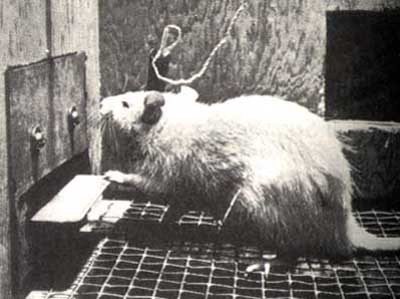
there's this famous experiment with a rat and a magic lever. the magic lever is electrically wired to the rat's innermost pleasure centres. so every time the rat presses the lever, he gets a brief taste of rodent heaven.
do you know what happens to the rat? he doesn't just push the lever a a few times for kicks, he pushes it until he starves to death. that's right. he'll even ignore food put right next to him. the sheer artifically-induced pleasure circumvents his own Darwinian instincts to survive.
i love this image. it's so beautiful. because inside of this image, lies the truth about all living things. from a macroscopic perspective, it really does seem that we are all just a bunch of rats pressing our own levers day in and day out. this gives birth to irrationality. the world can produce enough food to feed the entire world but so many countries are left starving ("goddamn this food sucks!"). in countries where there are enough resources to satisfy everyone, people are not satisfied unless they have more than everybody else ("you just see, i've gonna be rich!
木曜日, 8月 04, 2005
random links
www.pharmapolitics.com
The Good Drug Guide
http://www.thegooddrugsguide.com
Wikipedia's entry from methylphenidate (Ritalin) which is basically a variant of speed
http://en.wikipedia.org/wiki/Methylphenidate
火曜日, 8月 02, 2005
photography << music << movie-making
I have never tried to shoot a movie but I only shudder at the utter complexity it involves. I sincerely respect all great movie directors because it must be fucking impossible to shoot a good movie, let alone come up with the script, the camera angles, the pace of the cuts, yada yada yada. And let's not forget assembling a crew of people, dealing with petty actors and actresses... quite honestly it sounds like a goddamn nightmare.
Photography though, is like kiddie art.
Ever thought of it this way. Both music and movies have the element of time. That is, time is an intrinsic element. You can't have music without a duration, you can't have movies without a duration. But photography completely lacks the dimension of time. So it's one dimension shorter in complexity, and that's pretty fucking huge. And unlike say drawing a painting, photography is all about hitting a fucking button when you see something nice. Oh, fuck, that's so goddamn tough! I mean yeah, I can talk about aperture sizes and depth of fields and shit like that, so fucking what. Photography is technically a very shallow art. Hence it's widespread popularity. It provides incredibly quick gratification for relatively little effort. It's like photography is strictly in P while most other arts are in NP.
Yeah I know what you're thinking. Ok, Terry, just because you shot a few decent pics doesn't make you qualified to diss photography. You know what? I'm pretty fucking qualified. I honestly don't see a massive difference between that flower picture and say other pics you will find on the Internet taken by "professional" photographers. Maybe there is to some photography faggots, but I don't see it. In contrast, after so many years of trying to figure out how to make music, and I pretty much almost went mentally insane trying to figure out all the stupid tricks to making a good track, I still cannot achieve what the average commercial producer can do.
Do you know how difficult it is to make music from scratch? Well, it's just like trying to write code from scratch. The mind is overwhelmed at a fucking blank piece of paper, because the number of possible directions overwhelms the mind. NP complexity. It's a lot easier to modify existing code because with existing code a lot of things are already dealt with, and you just have to fill in holes or modify parts. Any coder will relate to that, I bet. Ok, where was I? Right, making music. It's fucking difficult. For one thing, the first problem almost everybody experiences is in mixing. You need the right amoutn of bass, midrange, and treble which are the sums of the various instruments. Nobody gets that right the first time, and even I get that wrong all the time. The problem is that the ear normalizes after hearing something a hundred times in one sitting. And then you need to deal with how the song varies over time. What instruemnts are you going to use? People can honestly spend hours looking for a decent instrument or synth patch and then they've already lost their train of mind. Happens all the time. Just ask Prodigy. And then if you have to deal with vocals OMFG. I won't even get into that. It is fucking DIFFICULT to even get a clean vocal recording unless you own a real studio.
Photography? Just make sure you don't shake the camera and you can get vivid colors and sharp images within hours with any decent consumer camera. All those tripod-toting SLR manual focus faggots can kiss my ass. People who actually bother to make their camera record in RAW instead of JPG are morons too. You spend all that effort and your results have nothing to show for it. Everytime I see some unbelievable average picture in a magazine with the "Photos by Faggot X" I can't believe how fucking self-absorbed photographers are.
Ok, I have to admit there are a couple of photographers I respsect. The first kinds are the ones who go to Lebanon or some war-torn zone and risk their very lives to take a good shot of some dictator. Holy fuck, now that's passion for your job. Nature photographers are also pretty l33t because unlike the regular faggots, they have to think about how to approach the subject. That's about it. I was going to include the NBA photographers who post those unbleievably clear photos of fast-moving subjects on nba.com but that's primarily custom-tailored equipment.
I have no idea of the workflow of movie-making but that's another order of magnitude above what I know right now. Ultimately though, the most hardcore geniuses lie in the domain of mathematics. I guess after reading that book about Prime Numbers it just goddamn scared me how complex the mind of a great mathematician is. Mathematicians make faggot photographers look like turd.
What the FUCK am I talking about.
Wallpaper-ready Macro Shot

月曜日, 8月 01, 2005
random macro continued

